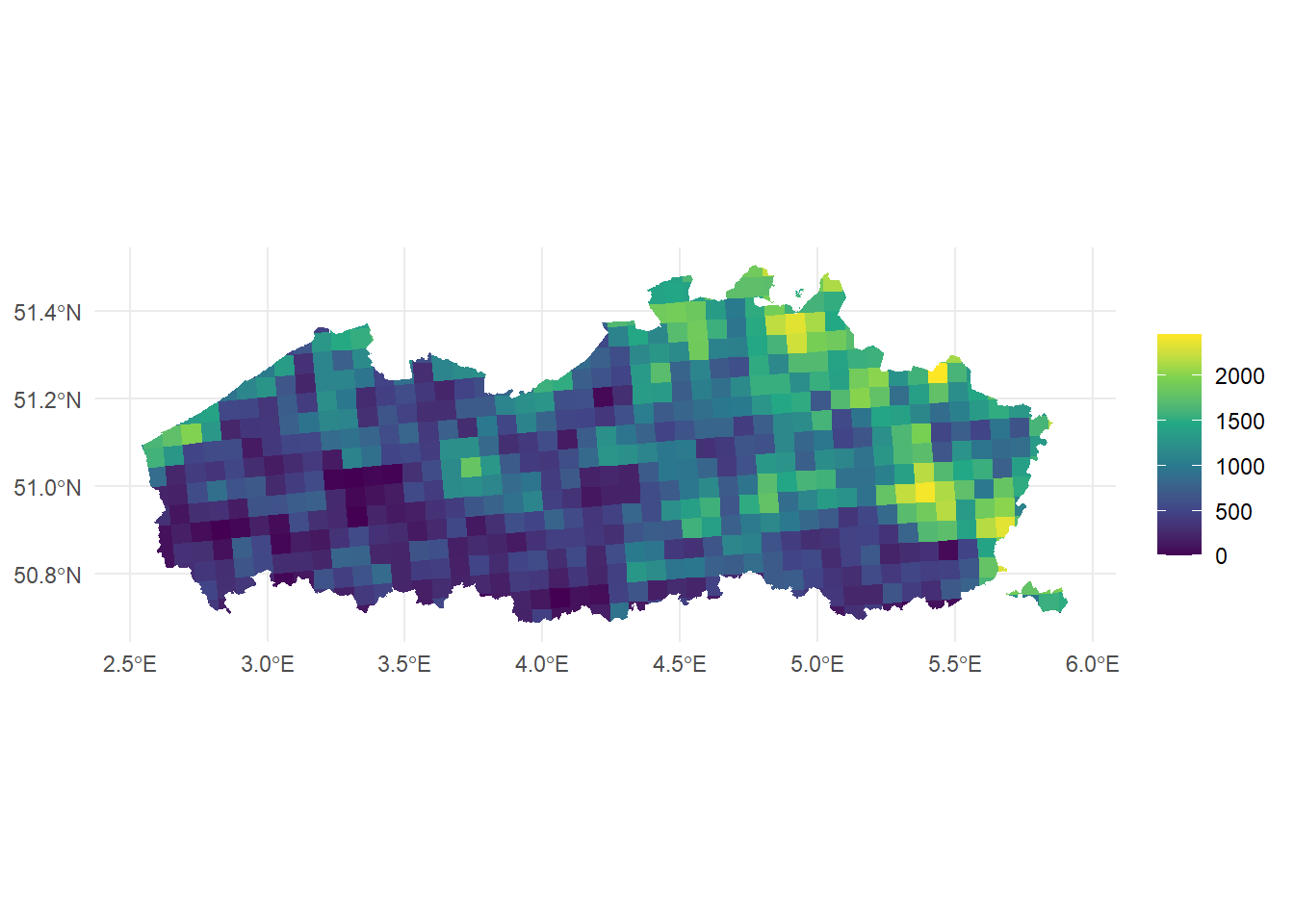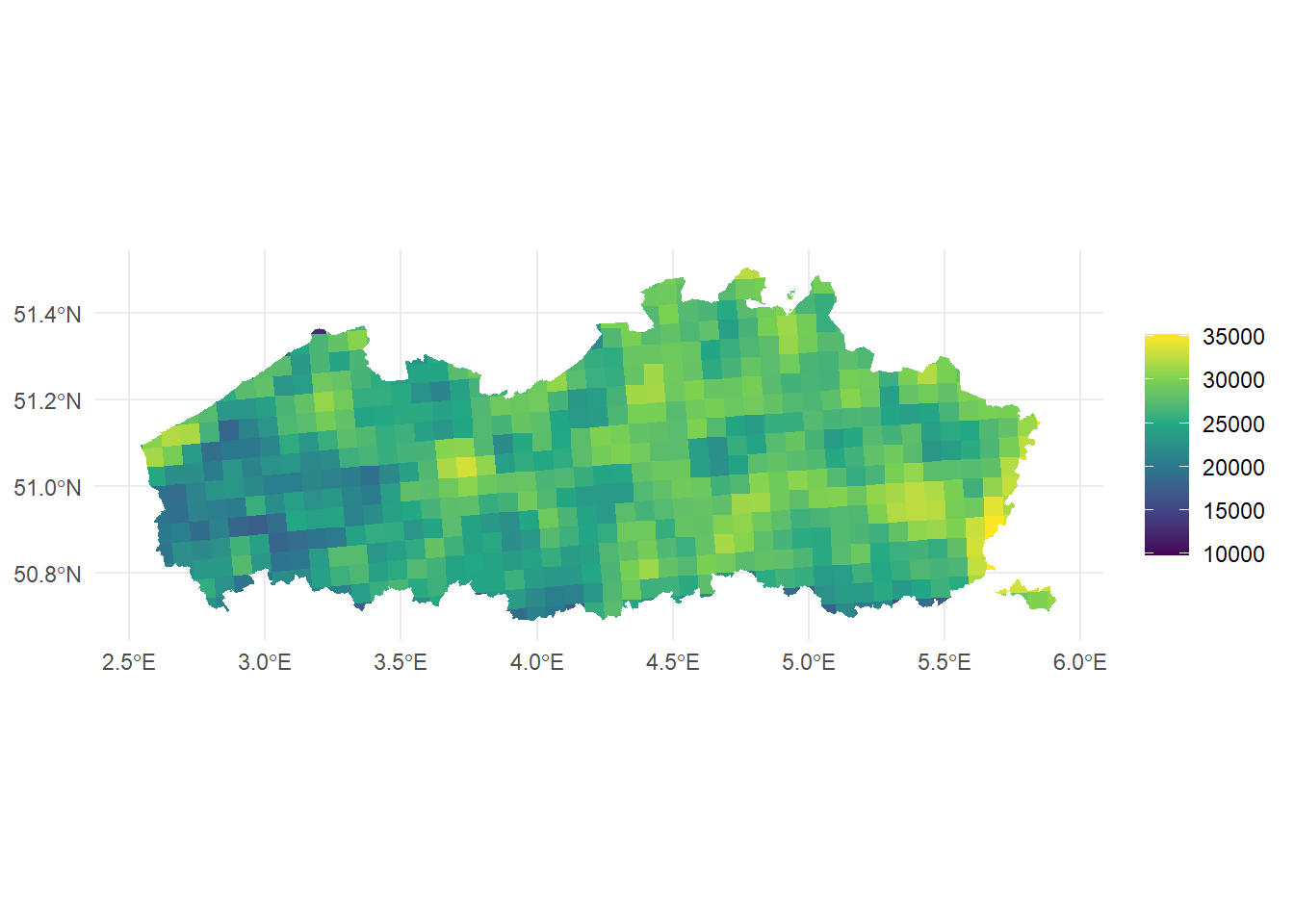
Phylogenetic diversity 5km
The indicators displayed below were calculated for flowering plants recorded in Flanders from 1975 onwards. Details of the download settings are available from GBIF.org (17 March 2026) GBIF Occurrence Download https://doi.org/10.15468/dl.y9hpfa.
TipPhylogenetic Diversity loss map
Indicator type
Pressure/ecosystem indicator.
Explanation
This indicator calculates exactly how much evolutionary history we stand to lose if threatened species disappear from a specific grid cell. Species are considered ‘threatened’ when classified as Critically Endangered (CR), Endangered (EN) or Vulnerable (VU) according to the local IUCN Red List. The total Phylogenetic Diversity is then once calculated with all species present; and second, without the threatened species. The difference between these two scores equals the Expected PD Loss.
High value (High Expected Loss): If the threatened species in this grid cell go extinct, a substantial chunk of the evolutionary tree of life and the feature diversity associated with it for this region will vanish. This happens because these endangered species have no close relatives in these cells that share their evolutionary history and evolved traits.
Low value (Low Expected Loss): The threatened species in this cell are either close cousins to other common species (meaning their disappearance won’t completely delete that branch of the tree of life) or there are few threatened species present in the area.
Applicability for policy
This indicator provides a “triage map” for policymakers and conservation agencies that highlights the areas where the loss of evolutionary heritage is expected to be greatest. Rather than just looking at the decline in species richness alone, it also considers the variety of features across the evolutionary tree of life. Resources can then be allocated towards high-priority areas, for example, to expand protected areas to include hotspots of evolutionary heritage.
Limitations
This indicator treats all “threatened” categories (CR, EN, VU) with equal weight when calculating the expected loss, and therefore, it does not differentiate between a species that is on the brink of extinction versus one that is vulnerable. Furthermore, it relies on the up-to-date accuracy of regional Red Lists, and therefore, the potential loss of a species that has become threatened but is not officially assessed yet will not be factored in.